
Introduction
In today’s world, where technology is advancing at a dizzying pace, choosing the right programming language can make a significant difference in a developer’s career. C# is one of the most popular and widely used programming languages among developers worldwide, developed by the renowned tech company Microsoft.
In this article, we aim to provide a comprehensive overview of C#, including its history, features, advantages, applications, and the reasons behind its growing popularity. If you are looking to learn or choose a programming language for your upcoming projects, this article is a must-read.
#History of C
C# was born in the late 1990s and early 2000s, at a time when Microsoft sought to develop a modern and powerful platform for building versatile software. The primary architect of this language was Anders Hejlsberg, who had previously designed successful languages such as Delphi and Turbo Pascal.
C# was introduced as part of the .NET Framework by Microsoft—a modern, safe, readable, and flexible language designed for developing a wide range of applications. Later, with the introduction of .NET Core in 2016 as an open-source and cross-platform version, a new era began for .NET and C#. Microsoft then simplified the platform with the new .NET versions, released sequentially as:
.NET 5 in 2020
.NET 6 (LTS) in 2021
.NET 7 in 2022
.NET 8 (LTS) in 2023
.NET 9 in 2024
This evolution made C# a core and vital component of the .NET ecosystem, widely used today in web development, desktop applications, mobile apps, cloud computing, game development, IoT, and even artificial intelligence.
Why C#? Key Features and Advantages
C# combines the powerful features of languages like C++, Java, and Delphi in a simpler and safer form. Here are its main features:
1. Full Object-Oriented Programming
C# was designed from the ground up as an object-oriented language. It fully supports concepts such as classes, objects, inheritance, polymorphism, abstraction, and encapsulation. This makes project structures more organized and code maintenance easier.
2. Strong Type Safety
Unlike languages like JavaScript or Python, where types are dynamically managed, C# uses strong and static typing. This prevents many runtime errors and enhances program security.
3. Automatic Memory Management (Garbage Collection)
Developers in C# do not need to manage memory manually. The Garbage Collector automatically frees unused resources, helping prevent memory leaks.
4. LINQ Support
C# supports LINQ (Language Integrated Query) for searching and filtering data in arrays, lists, and databases. This feature improves code readability and reduces complexity.
5. Asynchronous Programming
With the keywords async and await, developers can perform operations such as reading files, making server requests, or accessing databases asynchronously. This improves performance and responsiveness, especially in web and mobile environments.
6. Full Compatibility with the .NET Platform
C# is fully compatible with the .NET framework, allowing developers to leverage thousands of ready-made libraries and tools. This speeds up software development significantly.

#Applications of C
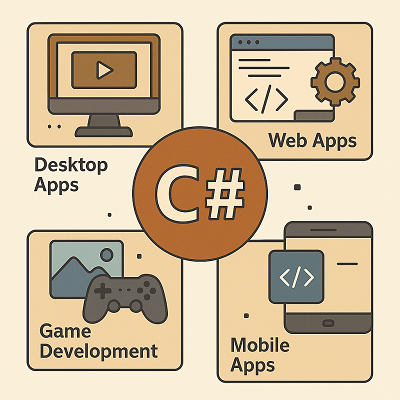
Due to its flexibility and extensive support, C# is used in various domains. The main applications include:
1. Desktop Software Development
Using libraries like Windows Forms and WPF (Windows Presentation Foundation), developers can create professional software for Windows. Visual Studio provides an excellent environment for designing user interfaces (UI).
2. Web Development and APIs with ASP.NET Core
C# is a primary language for building dynamic websites and APIs. ASP.NET Core offers high performance, a modular structure, and cross-platform hosting on Windows, Linux, and macOS.
3. Mobile App Development with Xamarin and MAUI
C# enables the development of Android and iOS apps using Xamarin and, more recently, .NET MAUI (Multi-platform App UI). These tools allow developers to write code once and run it on multiple platforms.
4. Game Development with Unity
The popular game engine Unity uses C# as its primary scripting language. Many mobile, PC, and console games are developed using the combination of Unity and C#.
5. Data Science and Artificial Intelligence
While Python dominates data science, C# can also be used for implementing machine learning models and data analysis through tools like ML.NET.
Benefits of Learning C# for Developers
Learning C#, especially for beginners, offers numerous advantages:
Structured and Readable Code
C# code is organized and easy to read.
Comprehensive Tool Support
Visual Studio provides excellent development, debugging, and testing capabilities.
Wide Job Market
Due to its extensive use in major companies, there are abundant career opportunities for C# developers.
Active Community and Learning Resources
Thousands of articles, videos, courses, and forums are available for learning C#.
C# in 2025: A Language for the Future
With new .NET versions and cross-platform frameworks like MAUI, C# is becoming one of the most versatile tools for software development. From web development to mobile apps, desktop applications, and game development, C# covers it all.
Supported by one of the world’s largest tech companies, C# has a promising future. Features like Minimal APIs, Blazor, Source Generators, and Hot Reload in the latest versions make programming with C# faster and more enjoyable than ever.

Conclusion
C# is a smart choice for modern developers. Whether you want to build a mobile app, design a complex website, or create a professional game, C# provides powerful and complete tools.
If you are looking for a modern, powerful, versatile, and future-proof programming language, start learning C# today.
 Twitter
 Telegram
 LinkedIn
 Facebook
 Eitaa
Eitaa Rubika
 Mohammad Shahnazarli
Software Developer with over 15 years of experience in .NET, enterprise system design, and SEO optimization.
Passionate about sharing knowledge and continuous learning.
Mohammad Shahnazarli
Software Developer with over 15 years of experience in .NET, enterprise system design, and SEO optimization.
Passionate about sharing knowledge and continuous learning.
Submit your comment